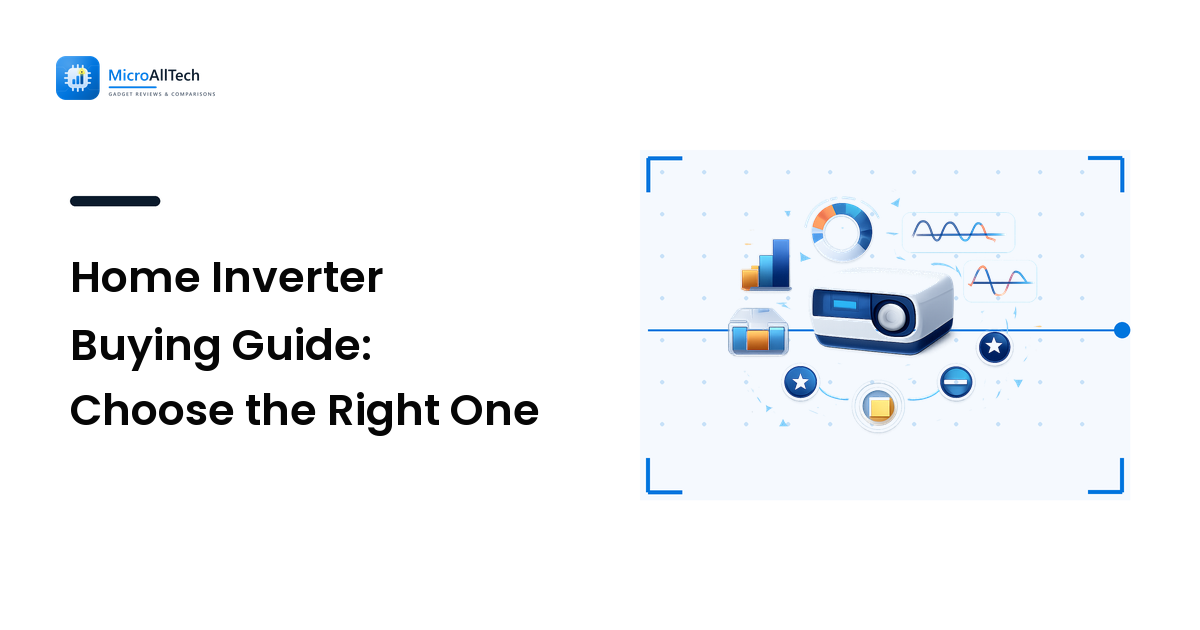
A home inverter is one of those purchases where the showroom pushes numbers that sound impressive but rarely match what your house actually needs. Salespeople quote big VA ratings and premium batteries because that's where the margin sits — not because your fridge and a few lights require them. This buying guide for home inverter shoppers strips it back to the decisions that matter: how much power you truly need to back up, what kind of battery to pair with it, and which specs are worth paying for.
The short version: add up the watts of the things you must keep running during an outage, choose an inverter sized to that load with a little headroom, and then pick a battery based on how many hours of backup you want. Get those three right and a mid-range setup will serve you better than an oversized one chosen on spec-sheet bravado.
Start with your load, not the inverter rating
The single most common mistake is buying by VA rating alone. The right starting point is a load calculation — a simple list of every appliance you want running when the grid is down, with its wattage.
Write down the essentials: lights, ceiling fans, a television, a router, phone chargers, and maybe a refrigerator. Add up their running watts. That total is the real number your inverter has to serve. Everything about the purchase flows from it, so do this before you look at a single product.
Two cautions when you total the list:
- Motor-driven appliances draw a surge. Fridges, water pumps, and air conditioners pull two to three times their running wattage for a moment when they start. Your inverter has to survive that spike, not just the steady draw.
- Leave headroom. Size the inverter so your normal load sits around 70–80% of its capacity. Running an inverter at its absolute limit shortens its life and leaves no room to plug in one more thing.
Once you have a realistic wattage figure, converting it to the VA rating retailers advertise is straightforward, which is the next step.
How to read the VA rating (and why watts come first)
Inverters are sold by VA (volt-amperes), but your appliances are rated in watts. The two are linked by a power factor — for typical home loads, roughly 0.7 to 0.8. In plain terms, an inverter's usable watts are about 70–80% of its VA number.
So a 1,000 VA inverter realistically supports around 700–800 watts of load. Work backward from your load total: if your essentials add up to about 600 watts, a 1,000 VA unit gives comfortable headroom; if they hit 900 watts, step up to a 1,500 VA class. The reason to buy on watts first and VA second is that VA alone tells you nothing until you apply the power factor — and that's exactly where an oversized "just to be safe" purchase quietly wastes money.
Pure sine wave vs modified sine wave
This is the specification most worth understanding, because it affects what the inverter can safely run.
- Pure sine wave produces clean power almost identical to the grid. It runs everything — sensitive electronics, variable-speed motors, medical devices, and modern appliances — without buzzing, heat, or compatibility issues. The trade-off is a higher price.
- Modified sine wave approximates the waveform in steps. It's cheaper and fine for simple resistive loads like basic lights and fans, but it can cause humming in fans, overheating in some motors, and problems with sensitive electronics.
The decision rule: if you're backing up a fridge, computers, or anything with a motor or delicate circuitry, pay for pure sine wave — the compatibility and appliance safety are worth it. Choose modified sine wave only for a bare-bones setup of lights and fans on a tight budget, and accept the trade-off knowingly. For most homes today, pure sine wave is the sensible default.
Buying guide for home inverter battery: the part that decides backup time
The inverter sets what you can run; the battery decides how long. This is where most of your money goes over the life of the system, so it deserves its own attention.
Battery capacity is rated in amp-hours (Ah). More Ah means more backup time for the same load. To size it, decide how many hours of backup you want for your load, then match the Ah rating accordingly — a larger fridge-and-lights load over several hours needs far more capacity than a couple of lights for one hour. Here are the common types and their trade-offs:
- Flat-plate lead-acid: cheapest upfront, good for areas with short, frequent outages. Trade-off: shorter lifespan and regular maintenance (topping up water).
- Tubular lead-acid: the workhorse for long, frequent outages. It costs more but lasts longer and tolerates deep, repeated discharge better. For most homes with regular power cuts, tubular is the value pick.
- Lithium (LiFePO4): lightest, longest-lived, maintenance-free, and fastest to charge. The trade-off is a much higher upfront price, though the longer service life narrows the gap over time.
Two rules protect your investment: match the battery voltage to the inverter (a single 12V battery for smaller units, multiple batteries in series for larger ones), and put the battery somewhere ventilated, since lead-acid types release gas while charging.
Buying guide 2026: which features actually matter now
Newer inverters pile on features, but only a few change your experience. Judge them by function, not marketing, the same way you would with any tech purchase — our broader guide to choosing tech applies the same discipline of spending on what you'll actually use.
Worth having:
- Pure sine wave output, as covered above, if you run anything beyond basic lights.
- A good charging system (ideally with a fast or smart charge mode) so the battery is ready before the next outage.
- Overload and short-circuit protection, which protects both the inverter and your appliances.
Nice but not decisive: app connectivity, LCD dashboards, and multiple display readouts. They're pleasant, but don't let a screen or an app decide the purchase over capacity, waveform, and battery quality. Spend on the parts that keep the lights on, and treat the extras as tie-breakers.
Best home inverter: how to actually pick the winner
There's no single "best" inverter — the best one is the one matched to your load, your outage pattern, and your budget. A genuinely good pick comes from the criteria above, applied in order:
- Capacity sized to your real wattage with 20–30% headroom.
- Waveform — pure sine wave unless your load is truly just lights and fans.
- Battery type matched to how long and how often your power fails.
- Protection and charging features that guard your investment.
- Reliable service and warranty in your area, because an inverter is a multi-year purchase and support matters when it eventually needs it.
Rank candidates against those, in that order, and the right model usually picks itself. Beware any recommendation with no trade-off — a big rating at a low price almost always compromises on waveform, battery quality, or build.
Does the brand matter the way it does for phones?
With phones, people search "buying guide Apple" or "buying guide Samsung" because the ecosystem and software lock-in genuinely shape the decision. Inverters aren't like that. There's no ecosystem to buy into, so brand should weigh less than capacity, waveform, battery, and local support. A well-known brand can be worth a modest premium for one practical reason — reliable after-sales service and warranty coverage where you live — but pay for the service network and build quality, not the badge. Judge inverters on the fundamentals, and let a trusted name be a tie-breaker, not the headline.
FAQ
What size inverter do I need for a home?
Add up the running watts of the appliances you want during an outage, then pick an inverter whose usable wattage (about 70–80% of its VA rating) comfortably exceeds that total with 20–30% headroom. A typical essentials load of lights, fans, a TV, and a router lands most homes around a 1,000–1,500 VA unit.
Is a pure sine wave inverter worth the extra cost?
For most homes, yes. Pure sine wave runs sensitive electronics and motor-driven appliances cleanly and safely, avoiding the humming, heat, and compatibility problems that modified sine wave can cause. Choose modified sine wave only for a basic lights-and-fans setup on a tight budget.
Which battery gives the longest backup?
Backup time depends on amp-hour (Ah) capacity relative to your load, not the inverter. For long, frequent outages a tubular lead-acid battery offers the best value and durability; lithium (LiFePO4) lasts longest and needs no maintenance but costs more upfront.
Can one inverter run a refrigerator?
Yes, if it's sized for the fridge's surge. Motors briefly draw two to three times their running wattage at startup, so choose an inverter with enough capacity to absorb that spike, and prefer pure sine wave to protect the compressor.
Next step
Before you compare a single model, do the deciding work at home: list every appliance you must keep running, add up the watts, and note whether any of them have motors. Size the inverter to that load with headroom, pick pure sine wave unless it's truly just lights and fans, and choose the battery by how long and how often your power fails. Buy the capacity and the waveform, match the battery to your outages, and skip the gimmicks — you'll have backup power that just works, long after the spec sheet is forgotten.